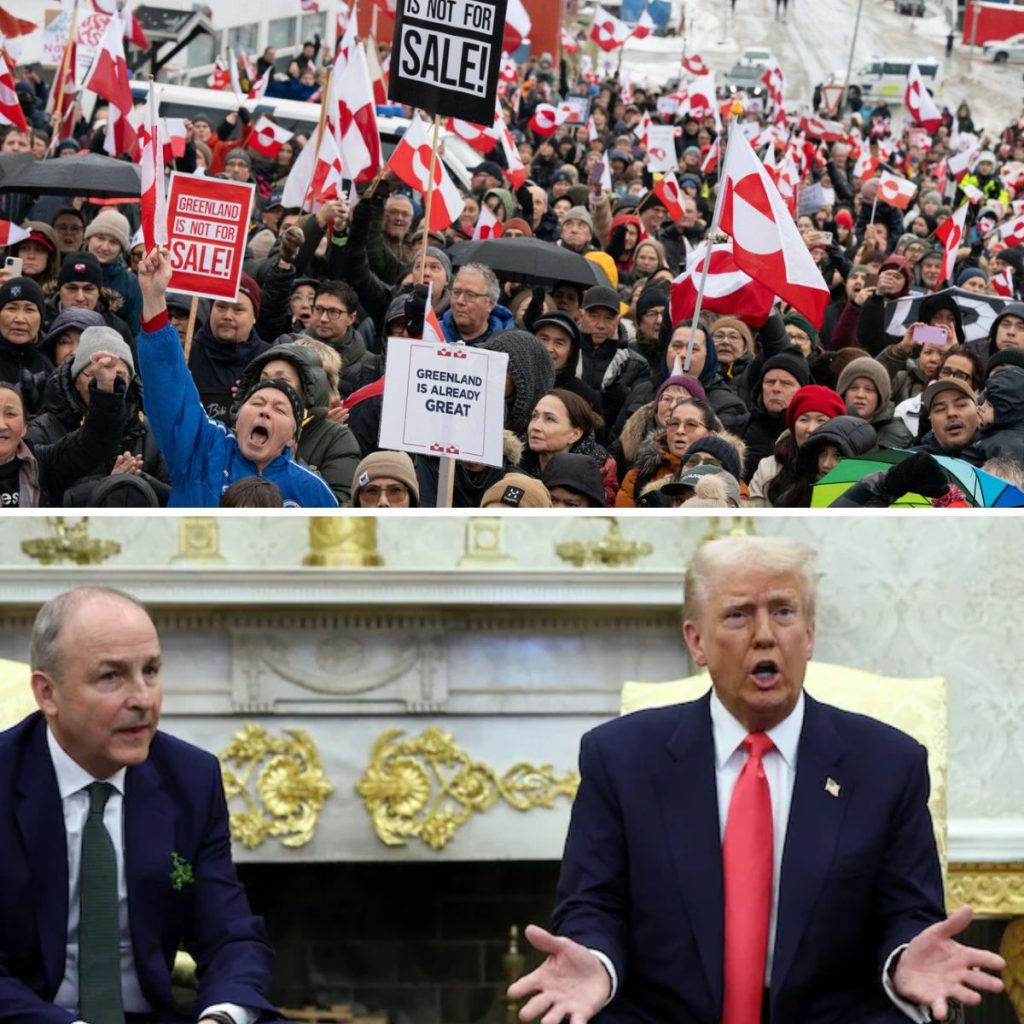
US President Donald Trump announced new tariffs of 10% on eight European nations, but the UK and EU said they won’t be drawn into a tit-for-tat trade war.
TÁNAISTE SIMON HARRIS said now is “a time for cool heads” as he met with fellow European finance ministers in Brussels to discuss Donald Trump’s threat to impose tariffs on eight European nations.
On Saturday, Trump announced that he would be levying tariffs of 10% on all goods sold in the US by eight European nations until the US acquires Greenland.
The tariff on Denmark, Norway, Sweden, France, Germany, the United Kingdom, the Netherlands and Finland would come into effect on 1 February, he said. The tariff would then increase to 25% in June.
The Finance Minister said the “destabilising effects of the recent geopolitical developments could potentially be enormous. That’s why it’s more important than ever that we seek dialogue” with the US.
Harris said Europe has worked “very hard” to reach a trade agreement with the US last summer following the initial tariff threat, where EU Commission President Ursula von der Leyen and Trump agreed upon a 15% tariff rate on EU goods sold in the US.
“Anything that now moves away from that or deviates from that could have potentially very, very significant consequences,” Harris said.
He stressed that Ireland and Europe stands with Greenland and Denmark.
The European Council is to hold an emergency summit in the coming days, where leaders are to discuss next steps in light of Donald Trump’s threats to take over Greenland.
The US President said he no longer feels an obligation to think “purely of peace”, in a letter sent to the prime minister of Norway, in which he also expressed anger at his not receiving the Nobel Peace Prize.
UK Prime Minister Keir Starmer said the dispute over Greenland, which Trump wants to take over because of its strategic Arctic location and mineral wealth, should be resolved through “calm discussion between allies” rather than military action or a trade war.
Britain has signalled that it won’t be drawn into a tit-for-tat trade war with the Americans and impose retaliatory tariffs, with Starmer insisting this is “not the right way to resolve differences within an alliance”.
In Europe, political leaders are to meet in the coming days to discuss their joint response.
President of the European Council António Costa said it is wants to support Denmark and Greenland. It is the council’s view that tariffs would undermine transatlantic relations and are incompatible with the EU-US trade agreement.
“We will not allow ourselves to be blackmailed,” said Germany’s vice chancellor Lars Klingbeil.
“Europe will respond with a united, clear response, and we are now preparing countermeasures together with our European partners.”
Klingbeil said Europe’s response could have three main strands.
Related Reads

Trump cites Nobel Peace Prize snub in angry letter about Greenland to Norway’s PM

The fight for resources: If 2025 was the year of war, 2026 could be the land-grab year
First, the current tariff deal with the United States would be put on hold, he said.
Second, European tariffs on imports from the United States, currently suspended until early February, could come into force, said Klingbeil, who is also Germany’s finance minister.
And thirdly the EU should consider using its toolbox of instruments that can be deployed to respond to “economic blackmail” against Washington, he added.
Over the next two days, Harris is scheduled to attend meetings of the Economic and Financial Affairs Council (ECOFIN) and the Eurogroup.
These are the first meetings of both this year.