I watched son die twice after risky test destroyed his final months – I’m warning others so his suffering wasn’t in vain
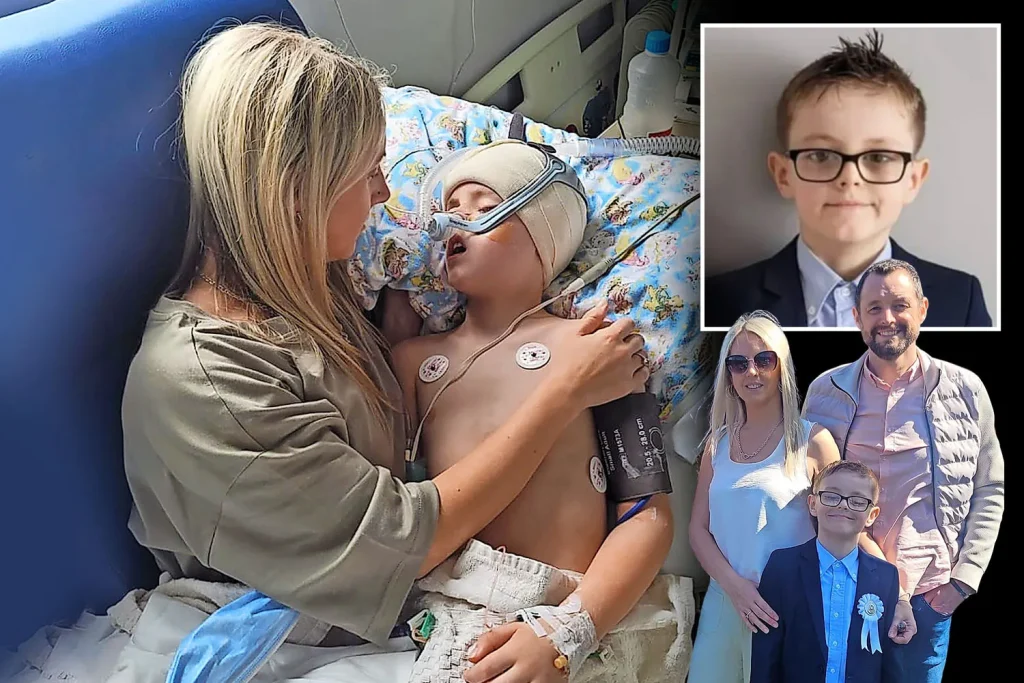
Diffuse Intrinsic Pontine Glioma is a very rare cancer, with fewer than five children per year diagnosed with it in Ireland – and just 22 patients were treated for the condition here between 2019 and 2023.
THE mother of a boy who was left in a vegetative state after a brainstem biopsy today tells us: “I watched my son die twice.”
Brody Doyle, nine, died last year after he was diagnosed with the rare and inoperable brainstem cancer Diffuse Intrinsic Pontine Glioma (DIPG).


The Dublin lad’s “deeply troubling story” was raised in the Dail this week as concerns were raised about the number of risky biopsies being carried on kids in Irish hospitals.
These are procedures to remove a small sample of tissue of cells to be examined under a microscope.
But Brody’s last months with his family were marred by extreme complications after a biopsy on the tumour on his brain left him unable to move, speak or swallow.
Mum Kirsty wants to tell her son’s story in the hope another family does not have to go through the hell that they experienced.
She wants safeguards around informed consent put in place, to ensure families get a full explanation of any suspected diagnosis before a high-risk biopsy is carried out.
And Kirsty believes docs must spell out the benefits of procedures prior to consent being granted.
She also wants multidisciplinary reviews, with teams of doctors, to be made mandatory before biopsies in risky cases such as Brody’s, where they are operating on the brain.
Kirsty told The Irish Sun: “I don’t want Brody’s life and what he went through to go in vain.
“If we can save one more child and one more family from going through what happened to Brody, then it didn’t all happen for nothing.
“My son was already facing a terminal diagnosis, but what happened after that biopsy changed the time he had left. Instead of making memories, we were left trying to teach him to eat again.
“We can’t change what happened to him now, but we want answers from the Government and Children’s Health Ireland.”
Brody had symptoms of imbalance and issues with his eyes for years, before a scan eventually found a tumour on his brain in May 2024.
This was carried out on the Friday of a bank holiday weekend.
Doctors believed it was the rare cancer DIPG, which is inoperable and terminal, but wanted to carry out a biopsy to be certain.
‘HELL ON EARTH’
Minutes after the surgery, Brody’s brain haemorrhaged — and the little boy was left fighting for his life.
Mum Kirsty said the aftermath from the surgery was “hell on Earth” as her son was left paralysed and unable to move.
She added: “Brody came through the corridor from the theatre into the ward and I just knew something was wrong.
“He was making this grunting sound. He was paralysed already. He couldn’t talk. He had a seizure. I was screaming the hallways down. It took them about an hour and a half to resuscitate, intubate and stabilise him. He was having a massive brain haemorrhage.”
REHAB REQUIRED
Through treatment and work at the National Rehabilitation Hospital in Dun Laoghaire, Dublin, Brody managed to get some speech again and get some function back.
Kirsty said: “Brody was in Temple Street for five months. He fought like an absolute bear. He was fully there but he couldn’t move anything.
“I knew he was in there. He couldn’t talk. He couldn’t walk. He couldn’t eat. He could move one or two of his fingers.
“He started rehab and got to a point where he was starting to take soft foods and he was moving his hands and some speech eventually came back.
“When we moved to the National Rehabilitation Hospital, they were amazing. They willed him back. We got to the point where we got Brody upright onto a walker. It was just sheer determination from him.
“I watched sweat rolling down his face trying to lift up bean bags. He was an absolute warrior.
“He spent eight months in rehabilitation and for the next eight months it was all downhill. Three weeks after we left the NRH he had new symptoms and his cancer was progressing.”
CASE RAISED IN DAIL
Within weeks, Brody lost all the functions he had relearned. He passed away on August 15, 2025.
People Before Profit TD Paul Murphy brought up Brody’s case in the Dail this week.
He raised questions about the oversight of biopsies being carried out for serious brain conditions.
The Dublin TD said: “Over the summer I met with Kirsty and Barry who told me a heartbreaking and deeply troubling story about how their son Brody had been treated at CHI.
“He was diagnosed with DIPG in May of 2024. This is a very aggressive brain tumour which is inoperable and children are treated as palliative once they are diagnosed.
“He then had a very invasive and dangerous procedure of a biopsy. As a result of the biopsy he had a massive brain haemorrhage and his brain swelled to such a degree that the back of his skull had to be effectively cut off.
“He walked into the operating theatre in full command and the use of all his limbs and so on. After the operation, the biopsy, he could only move one of his eyes and he never learned to walk again.”
RARE CONDITION
Taoiseach Micheal Martin has vowed to follow up on the case.
But in response to queries from Murphy, Health Minister Jennifer Carroll MacNeill said fewer than five children per year are diagnosed with DIPG, an aggressive type of Diffuse Midline Glioma (DMG).
And she told the Dail 22 patients were treated for the condition here between 2019 and 2023.
In response to concerns about the number of biopsies taking place, the Minister said: “HSE and CHI has advised that over the past ten years, the international consensus has developed to recommend that a biopsy should be considered in all children who have imaging characteristics consistent with DMG/DIPG.
“Data from the National Cancer Registry Ireland indicates that 59 per cent of patients with DMG/DIPG received a diagnostic or staging procedure within a year of diagnosis. This includes biopsy, lymph-node excision, surgical exploration, endoscopic exploration and other diagnostic procedures.
“The nature of the diagnostic or staging intervention is a clinical decision. CHI has advised that all patients suspected of having DMG or DIPG are offered biopsies where technically possible, based on the location of their brain tumour.
“Whilst this form of childhood cancer is extremely rare, its impact is profound, and I sympathise deeply with any family impacted.”
When approached by the Irish Sun the CHI had no comment.